Purpose:
The plans for the HHA’s patients during a natural or man-made disaster. Individual plans for each patient must be included as part of the comprehensive patient assessment.
Regulation:§484.102(b)(1)
Policy:NA
Video:
Process:
- During Admission visit the Patient Individual Emergency Plan Tool will be completed in the Patient Booklet.
- Patient Information
- Document in full, each component:
- Check the box for Advanced directive that applies to this patient.
- Completely fill in: patient name, DOB, SOC date, Physician and contact number and pharmacy contact information.
- Document in full, each component:
- Acuity Level Determination
Determine the level the agency needs to react for each patient for an activated Emergency. This acuity level will be part of the Emergency Preparedness section in Point Care.
Check the box for the appropriate Acuity Level:
- 1- 1-2 Hours High Priority. Potential to be life threatening without care. Requires ongoing treatment to preserve life. The patient's condition may deteriorate or require inpatient admission. Example: Ventilator Dependent.
- 2-Same Day: Moderate Priority. Services for patients at this priority level may be postponed with telephone contact until emergency improves. A willing and able caregiver is available. Example: O2 dependent; wound care; life support medications (i.e. Insulin, TPN).
- 3- Within a week: Low Priority. Services for patients at this priority level may be postponed with little or no adverse effects. A willing and able caregiver is available or patient is independent in most ADLs. Example: O2 dependent with adequate O2 supply and means to have tanks refilled; GT feedings with adequate supplies and feedings.
- Emergency Contacts
Document at least one emergency contact.
- Patient Instructions:
Review with the patient/caregiver:
- Patient Information
Identify a safe place and how to prepare the home to minimize damage. In the event of an emergency or disaster, take your emergency supply kit to your safe place and notify your out-of-home emergency contact of your location and condition. Contact the emergency officials by calling 911 if you are injured. For Emerging infectious diseases stay in home and practice good infection prevention and control.
- Plan for potential/actual natural disaster
Document identification and plan for natural or man-made disasters pertinent to geographical location.- Documenting a plan provides patient awareness when such conditions are at high risk and allows patient/caregiver to plan appropriately.
- Example:
- States with high risk for hurricanes.
- States with high risk for flooding.
- States that are high risk for wild fires.
- States that are high risk for tornados.

- Example:
- Documenting a plan provides patient awareness when such conditions are at high risk and allows patient/caregiver to plan appropriately.
- Evacuation
Review with the patient:
If evacuation is needed (complete destruction of the patient residence), notify Aveanna Home Health and see instructions below. To facilitate transportation, appropriate care and/or the patient plans to:- Document in one of the sections to identify where the patient may evacuate to.
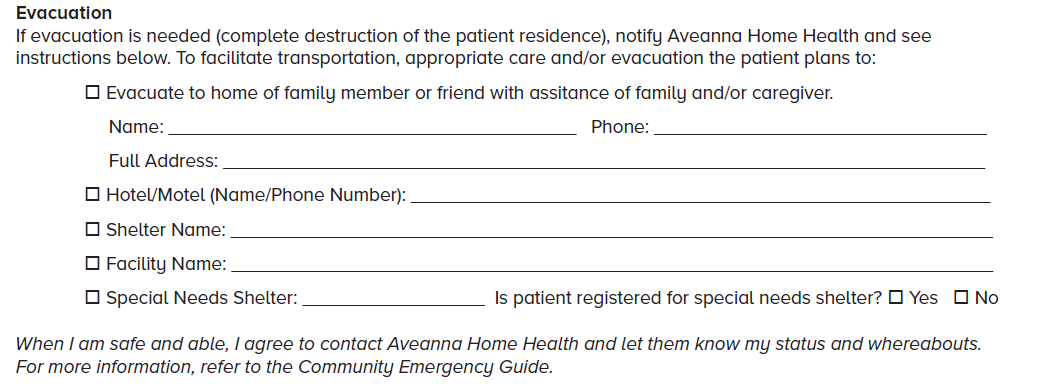
- The same information will then be transcribed into the point care device in the emergency preparedness section for evacuation.
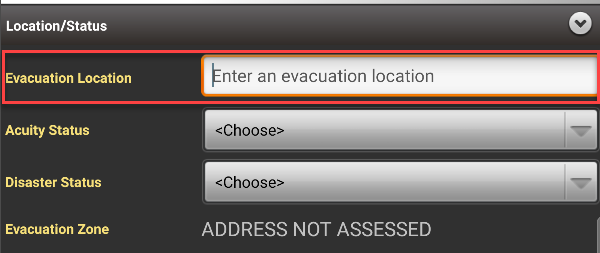
- Document in one of the sections to identify where the patient may evacuate to.
- Authenticate the Individual Emergency plan by signing, print name, add credentials, date and time.

- Using the Teams app, scan a picture of the Individual Emergency Plan and send to Medical Records in office. https://docs.aveanna.com/home/hchb-pointcare-uploading-photos-to-teams
- The original Individual Emergency plan will be left in the home so patient/caregiver are aware of the developed plan.
